
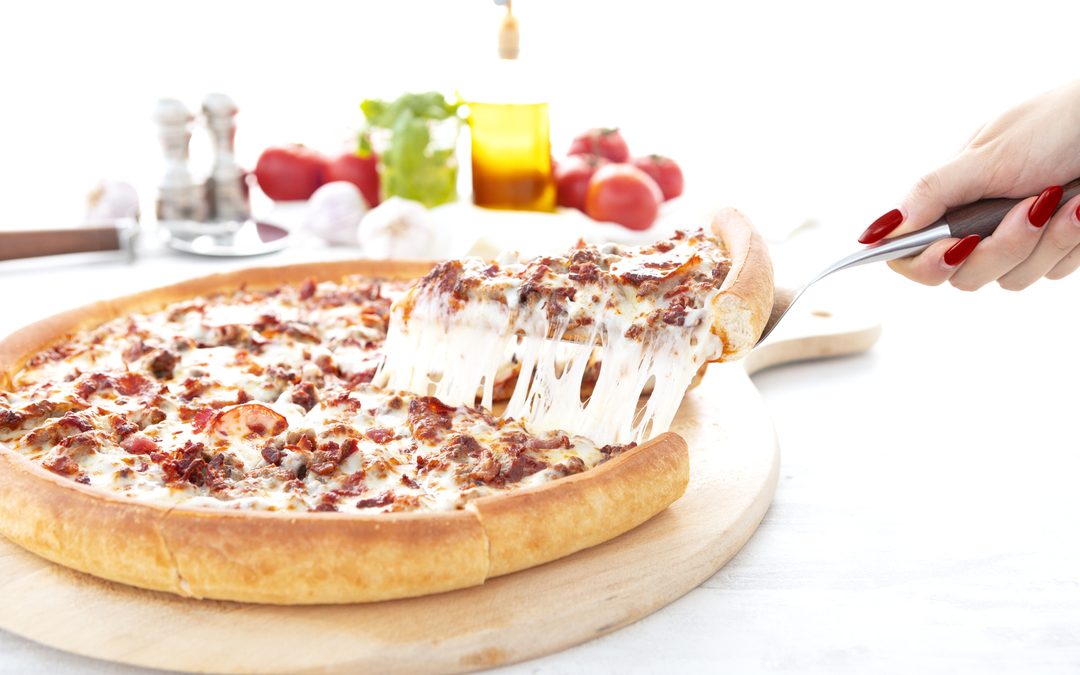
Plan on three slices per adult and one to two per kid, then round up. A large pizza cuts into eight slices, so one large feeds about two to three people before somebody grabs that last piece. The real wildcard is appetite spread, because the guy going back for a fourth slice and the toddler who eats half of one both blow up any neat formula.
The Psychology of Pizza Over-Ordering
Most people order too much pizza, and it’s not because they’re bad at math. Their brains work against them. When you plan ahead for a group, you instinctively load up on variety instead of sticking with what everyone would actually eat in the moment. Researchers call this diversification bias. You grab the specialty pie, the veggie option, the backup pepperoni, and suddenly you’ve got three extra pizzas nobody asked for.
Digital ordering makes it even easier to over-order. People placing orders online subconsciously add more food than they would over the phone. Seeing the full menu on a screen makes you a visual eater, where nothing feels excessive. You scroll past Cheesesticks, Breadsticks, Pizza Rolls, and Potato Wedges, and each one feels like a reasonable add-on that won’t change the total, until you realize you’ve loaded up on sides for an order that already had too much pizza.
The fix is simple math, not instinct. A large pizza gives you 8 slices, and the average adult eats 3. Say you’ve got ten people coming over. Ten times 3 slices equals 30 slices total. That’s four large pizzas, not the six your brain wanted to order. If you’re adding Breadsticks or Pizza Rolls to the spread, you can usually drop one more pie because those sides fill people up before they reach for another slice. Order what the math says. Your fridge will thank you.
Diversification Bias: The Science Behind Too Many Pies
Diversification bias is why your party ends with four barely-touched pizzas in the corner. When people choose food in advance for a group, they load up on variety instead of sticking with what everyone actually likes. You picture pepperoni, veggie, specialty, plain cheese. But put those same guests in front of a buffet, and most grab pepperoni twice.
Online ordering amplifies the whole thing. People ordering digitally subconsciously order more food than they would ever order by phone because they are visual eaters who feel far less constrained when the full menu is laid out in front of them with photos. Every option looks good on screen. You scroll past Classic Combo and think that looks great. Super Taco catches your eye. Hot Stuff looks even better. Then you throw in Pizza Rolls because the photo made them look perfect for appetizers. Before checkout, you have seven pizzas for twelve people when five would have covered everyone.
Simple math solves this. A large pizza typically yields 8 slices, and the average adult eats 3 slices per sitting. Twelve guests means about five large pizzas. Pick two or three flavors, order the right count, and spend the savings on Cheesesticks or Potato Wedges instead of buying that sixth pizza nobody asked for. Your guests care about eating good pizza while it is still hot, not having nine flavors cooling on the counter.
How Online Menus Trick Your Brain
Online menus are engineered to make you order more pizza than your group will actually eat. When you scroll through a digital menu instead of calling in your order, you see every specialty, every topping combination, every side all at once. That wall of visual options changes your behavior. People who order digitally consistently add more food to their carts than people who order over the phone.
The mechanism is simple. A phone call forces you to hold your entire order in your head, decide what you want, say it to a real person on the other end, and commit to the total before you hang up. An online menu removes all of that friction. Cheesesticks show up while you’re scrolling past the pizza section. Breadsticks sit in the sidebar. Pizza Rolls appear in a suggested items row. Each addition feels small, but your cart quietly grows past what anyone at the table will finish.
The fix is doing math before you start scrolling. The average adult eats 3 slices per sitting, and a large pizza gives you 8 slices. For a group of 10, that’s 30 slices total, which works out to 4 large pizzas. Write that number down before you open the menu. When the screen tempts you toward a fifth pizza or a wall of sides you didn’t plan for, your number is already locked in. You’re feeding the group you have, not the appetite the menu built for you. Do the math first, then order.
The Actual Formula for How Much Pizza You Need
The formula is simple: multiply your guest count by 3, then divide by 8. The average adult eats 3 slices of pizza per sitting. A large pizza typically yields 8 slices. Those two numbers are all you need. For 20 adults, that’s 60 slices divided by 8, which lands you at 7.5. Round up to 8 large pizzas and you’re covered for a full meal.
That baseline works for a group of adults eating pizza as the main course. Adjust for the actual crowd. Kids eat less than adults, so counting two kids as roughly one adult keeps the math honest. Birthday parties and family gatherings usually skew younger, which brings the total slice count down. Sides make a difference too. If you’re putting out Breadsticks, Cheesesticks, or Pizza Rolls alongside the pies, people fill up on appetizers first, grab fewer slices when the pizza arrives, and you end up with more leftovers than you expected. Pizza-only meals need the full 3 per person.
The formula scales to any group. Eight friends on game night. Forty relatives at a graduation party. A hundred coworkers in a conference room. Multiply by 3, divide by 8, round up. That’s your number. The most common pizza ordering mistake isn’t bad arithmetic. It’s skipping the arithmetic entirely and going with a gut feeling that has you adding two extra pies just in case. You’ve already read about how your brain pushes toward over-ordering. The formula overrides the instinct. Call Godfather’s with your headcount and we’ll tell you exactly how many pies to order before the guessing starts.
Group Ordering Mistakes Everyone Makes
The biggest group ordering mistake isn’t bad math. It’s treating every guest the same. People assume all adults eat identical amounts, ignore whether the event is a Saturday night dinner or a quick Tuesday office lunch, and pile on specialty pies that sit untouched while the cheese and pepperoni vanish in the first ten minutes. You already know the formula. Now stop undermining it with these avoidable errors.
Here’s what we see go sideways every week. A birthday party full of two-year-olds does not eat like a group of adults watching the Spurs game. Kids under five barely finish a single slice, so counting them as full eaters adds two or three extra pizzas nobody touches. Then there’s the variety problem. Someone orders five specialty pizzas for a twelve-person gathering when eight of those people just wanted pepperoni. Keep at least half your order in crowd-pleasers, then add one or two specialty pies for the adventurous eaters. When in doubt, order more cheese.
The other mistake is ignoring everything that isn’t pizza. Add Breadsticks or Cheesesticks to the table and people fill up before they ever reach for that third slice. That alone can knock a full pizza off your total. Timing matters just as much as headcount. A noon office lunch where people grab slices between meetings calls for less food per person than a Saturday night watch party where pizza is the entire meal. Adjust for kids, factor in sides, keep the specialty count low, and you’ll stop throwing away untouched pies at the end of every gathering.
How to Order the Right Amount Every Time
The key to ordering the right amount every time is treating the formula as a starting point, not the final answer. You already know the math: multiply your headcount by 3, divide by 8. That gives you the baseline number of large pizzas. Now adjust for the three things most people skip. What sides are you adding to the order? Are there kids in the group, or is this all adults? And how recently did everyone eat? Those three adjustments turn a rough estimate into an order that matches what your group will actually finish.
Sides shift the equation more than most people expect. Add Cheesesticks, Breadsticks, or Pizza Rolls to the table and guests eat less pizza per person. For a party of 20, that can knock a couple of large pizzas off the order without anyone going hungry. Kids under 10 eat far less than adults, so count them at roughly half the standard rate. Timing plays a bigger role than most hosts think. A noon lunch where nobody has eaten since breakfast demands the full pizza count. An evening order after an afternoon of snacking? Scale it back.
For bigger orders, call ahead. Walking into any kitchen and ordering 15 large pizzas during the Friday dinner rush puts the whole production line behind. Call us with the headcount, the time you need the food, and the general mix of toppings your group wants. We build it into the schedule so your pizza comes out hot with the right variety, not thrown together at the last second. Pickup takes about 25 minutes for a standard order. Delivery runs roughly 45 minutes. Work backward from when people get hungry, not from when you finally remember to order.
Resources Used
Frequently Asked Questions
How many slices are in a large pizza?
A large pizza typically yields 8 slices. That’s the standard cut at most shops, including Godfather’s. Some places slice their large pies into thinner pieces to get a higher count, but 8 is what you should plan around when estimating how much to order. Since the average adult eats 3 slices per sitting, one large pizza covers about 2 to 3 people at a full meal. For lighter occasions like an office lunch or afternoon meeting, you can stretch a large to feed 3 or 4. Always better to have a few slices left over than to come up short.
How many slices are in a medium pizza?
Medium pizzas are cut into fewer slices than a large, and the exact count varies by shop. The slices are smaller too, so they go faster than you might expect. For planning, figure a medium feeds about 2 adults at full appetite. If you’re ordering for a small dinner or just a couple of people, one medium handles the job. For parties, stick with large pizzas as your base since they give you the most food per box. Add a medium or two if you want extra topping variety without overcommitting to any single flavor. Ask your shop for exact slice counts when you call.
How many slices of pizza do I need for 20 adults?
The average adult eats 3 slices per sitting, so plan for around 60 slices total. A large pizza typically yields 8 slices, which puts you at about 8 large pizzas for the group. If you know your crowd has big appetites, go with 9 or 10 to be safe. Mix up the toppings so everyone has options, and throw in a couple of safe choices like pepperoni or cheese alongside anything adventurous. At Godfather’s, we put together party orders like this every week. Call us at 210-750-2222 and we can build the right mix for your group.
How many pizzas do I need for 7 people?
Start with the basics: the average adult eats 3 slices per sitting, and a large pizza typically yields 8 slices. For 7 adults, that comes to about 21 slices total, so 3 large pizzas gets you right there. Order a mix of toppings so everyone finds something they like. If kids are in the group, they eat fewer slices each, so 3 larges should be more than enough. For a group of 7 with big appetites or if this is the main meal with no sides, consider bumping it to 4 larges. At Godfather’s, 3 to 4 large pizzas handles a group of 7 comfortably.
How many pizzas should I order for 40 people at 2 slices each?
If everyone gets exactly 2 slices, that means 80 slices. A large pizza typically yields 8 slices, so 10 large pizzas covers it on paper. Here’s the catch: at most events, some people grab a third slice, especially if this is a full meal rather than a snack alongside other food. The average adult eats 3 slices per sitting, and a crowd of 40 will eat beyond what the minimum math suggests. You’re safer with 12 to 15 large pizzas for a group that size. Add sides like breadsticks or cheesesticks from Godfather’s to fill people up without needing extra pies.