
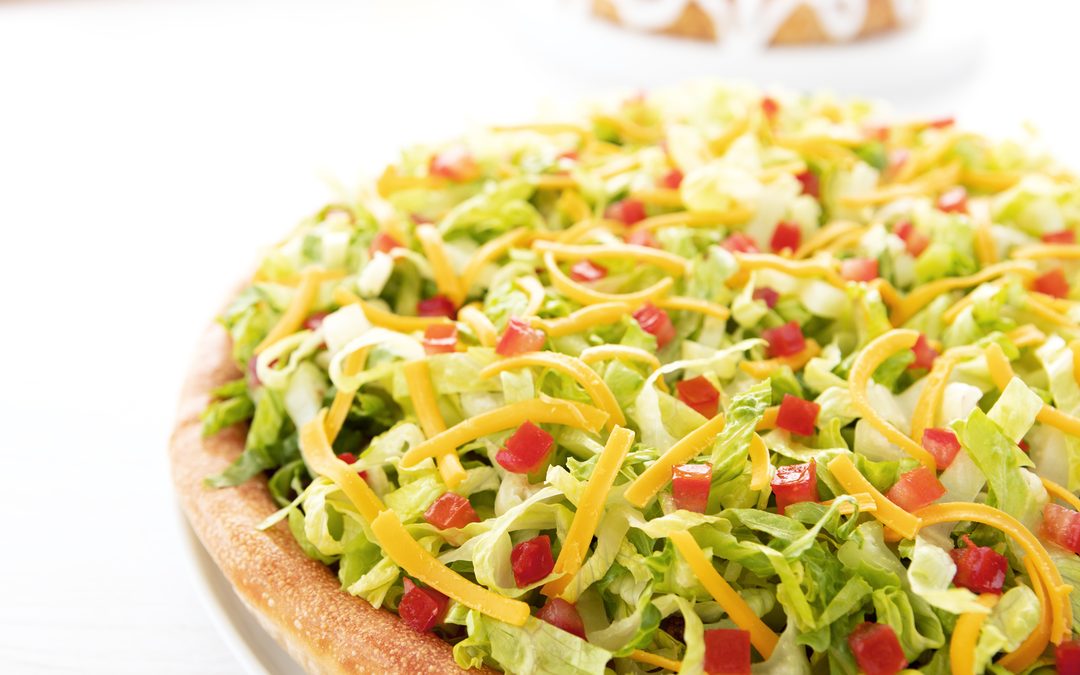
The taco pizza shouldn’t work. Pizza crust as a tortilla substitute, taco sauce instead of marinara, refried beans where no bean has gone before, and fresh lettuce on top of something that just came out of a 500-degree oven. It sounds like a late-night dorm room experiment — but it’s been one of the most popular specialty pizzas in the Midwest and Texas for over 40 years. More than a recipe, the taco pizza is a case study in American food evolution: how immigration, regional taste, franchise competition, and pure culinary stubbornness created a category that refuses to die. Here’s the full history.
Where Taco Pizza Came From
The taco pizza was born in the Midwest in the late 1970s and early 1980s — a product of the Tex-Mex boom meeting the pizza chain expansion, in a region that loved both but had neither in their traditional form.
- Midwest origins: Several Midwest pizza chains claim to have invented the taco pizza, including Happy Joe’s (Davenport, Iowa, founded 1972), Godfather’s Pizza (Omaha, Nebraska, founded 1973), and Casey’s General Stores (which started selling pizza in the mid-1980s). The exact “first” is debated, but the concept emerged simultaneously across the region
- The Tex-Mex context: Taco Bell had been expanding aggressively since the late 1960s, introducing middle America to Mexican-inspired flavors for the first time. By the late ’70s, taco seasoning packets were in every grocery store. The Midwest was primed for taco flavors on everything — including pizza
- The pizza chain context: By 1980, Pizza Hut, Domino’s, Little Caesars, and Godfather’s were all competing for menu differentiation. “More toppings” was the arms race. The taco pizza was a lateral move — instead of adding another meat or vegetable, someone replaced the entire flavor profile
- Why the Midwest specifically: The Midwest lacked the deep Italian-American pizza tradition of New York/New Jersey and the Tex-Mex saturation of Texas/California. This made Midwest diners more receptive to fusion experiments — they didn’t have strong opinions about pizza “purity” because they didn’t have a legacy pizza culture to protect
- The key innovation: Putting raw, fresh toppings (lettuce, tomato, sour cream) ON TOP of a just-baked pizza. This hot-cold, cooked-raw contrast was genuinely novel. No other pizza did it. The texture combination — crispy crust, melted cheese, warm beef, then cold crisp lettuce — created a sensory experience unlike anything in either the pizza or taco categories
Godfather’s Pizza and the Taco Pie
Godfather’s Pizza launched in 1973 in Omaha, Nebraska, founded by Willy Theisen. By the late 1970s, the chain had grown to hundreds of locations across the Midwest and was developing specialty pizzas to differentiate from the competition. The Taco Pie became one of the brand’s most enduring creations.
- Original recipe: Taco sauce base (replacing marinara), seasoned ground beef, onions, cheddar and mozzarella cheese — baked on the Original crust. After baking, topped with shredded lettuce, diced tomatoes, and extra cheddar. Sour cream served on the side
- Why it stuck: Unlike many specialty pizzas that come and go, the Taco Pie has been on the Godfather’s menu continuously since the early 1980s. It survived the chain’s ownership changes (including Herman Cain’s tenure as CEO), menu overhauls, and franchise restructuring. It’s still here because customers demand it
- The Super Taco evolution: Godfather’s later introduced the Super Taco — an upgraded version adding black olives, sour cream on top, and a taco seasoning packet per slice. Starting at current menu prices, it’s the “everything” version for people who want maximum taco-pizza experience
- San Antonio’s role: When Godfather’s was present in San Antonio in the 1980s and 1990s, the Taco Pie found natural resonance in a city where Tex-Mex flavors are native. When we brought Godfather’s back to San Antonio in 2025, the Taco Pie was the first thing people asked about. It wasn’t nostalgia for a brand — it was nostalgia for a specific product that can’t be replicated elsewhere
- Our current version: Our Taco Pie uses the same fundamental recipe: taco sauce, seasoned beef, onions, cheddar and mozzarella, baked on Original crust, topped with fresh lettuce, tomatoes, and extra cheddar after baking. Available in mini (check current menu) through large (check current menu). It’s consistently one of our top 3 sellers at the San Antonio location
The Taco Pizza Nationwide
The taco pizza isn’t a niche product — it’s a legitimate pizza category with a dedicated following across the country, especially in the Midwest and Texas.
| Chain/Brand | Product Name | Region | Notable Feature |
|---|---|---|---|
| Godfather’s Pizza | Taco Pie / Super Taco | Nationwide (franchise) | Original recipe, fresh toppings post-bake |
| Casey’s General Stores | Taco Pizza | Midwest (2,400+ locations) | Sells more taco pizza than any single variety |
| Happy Joe’s | Taco Joe Pizza | Iowa / Upper Midwest | Cult following, often cited as original inventor |
| Pizza Ranch | Taco Pizza | Midwest (200+ locations) | Part of their all-you-can-eat buffet |
| Taco Bell | Mexican Pizza (RIP/returned) | National | Different concept but similar fusion impulse |
| Frozen brands | Various taco pizzas | National (grocery) | Totino’s, Red Baron, private label versions |
- Casey’s dominance: Casey’s General Stores — a Midwest gas station chain with 2,400+ locations — sells more taco pizza than any other variety. In Iowa, their taco pizza is the most-ordered pizza of any kind from any source. A gas station pizza outselling every other option tells you how deeply the taco pizza is embedded in Midwest food culture
- Happy Joe’s cult status: Happy Joe’s in Davenport, Iowa frequently claims to be the original inventor of the taco pizza (late 1970s). Their “Taco Joe” pizza has a devoted following that treats it as the definitive version. The Happy Joe’s vs Godfather’s “who did it first” debate has been running for 40+ years with no resolution
- Frozen pizza market: Totino’s, Red Baron, and several private-label brands sell frozen taco pizzas in grocery stores nationwide. These are pale imitations of the restaurant versions — rehydrated beef, minimal fresh toppings, and a fraction of the flavor. They exist because the demand is real, but the quality gap between frozen and restaurant taco pizza is wider than any other pizza variety
- Taco Bell’s “Mexican Pizza”: Technically a different product (fried tortilla-based, not pizza dough), but it comes from the same cultural impulse — combining Mexican and Italian-American food forms. Its removal in 2020 and return in 2022 (after massive consumer backlash) demonstrated how emotionally invested Americans are in Tex-Mex/pizza fusion
Why the Taco Pizza Works
The taco pizza has survived 40+ years of menu changes, food trends, and pizza evolution because it solves a real dining problem and delivers a sensory experience that no other food replicates.
- The “everyone wins” solution: Half the table wants tacos, half wants pizza. The taco pizza gives both groups enough of what they want that nobody feels like they lost the dinner argument. It’s diplomatic food — a peace treaty between two cravings
- Novel flavor combinations: Cumin, chili powder, and garlic (from the taco seasoning) are flavors that traditional pizza never uses. They’re familiar from Tex-Mex but completely novel on a pizza crust — a combination that feels both comforting and exciting simultaneously
- Hot-cold textural contrast: The signature move — fresh lettuce and tomato on hot pizza — creates a temperature and texture contrast that straight pizza and straight tacos can’t replicate. The crisp, cold freshness of the lettuce against the warm, melty cheese is genuinely unique in the food world
- Regional pride: In the Midwest, the taco pizza is a point of local food identity — the same way deep dish is for Chicago or thin crust is for New York. People from Iowa and Nebraska defend their taco pizza with the same intensity. In San Antonio, the Taco Pie has the added resonance of being Tex-Mex flavors on pizza in a Tex-Mex city. It feels like it was made for this market
- Craveable specificity: Nobody craves “a pizza with various toppings.” People crave the TACO pizza — the specific combination of beef, beans, cheddar, lettuce, taco sauce. It has an identity that most specialty pizzas lack. You don’t say “I want the one with pepperoni and mushrooms.” You say “I want the Taco Pie.” That product-level craving is what keeps it on menus decade after decade
Tips for Eating It Right
The taco pizza has some specific eating considerations that set it apart from regular pizza: See also why pepperoni curls when it bakes.
- Eat it fresh: The fresh lettuce and tomato wilt within 20–30 minutes of application. The optimal eating window for a Taco Pie is the first 15 minutes after it arrives. After that, it’s still good, but the textural contrast diminishes as the lettuce softens
- Reheating the base: If you have leftover Taco Pie, reheat the crust, beef, and cheese portion at 375°F for 5–8 minutes. Then add fresh lettuce, tomato, and cheddar yourself. The base reheats beautifully — the fresh toppings just need to be replaced fresh
- Don’t fold it: Unlike New York pizza, the Taco Pie should NOT be folded — you’ll launch lettuce and tomato across the table. Eat it flat, either with hands or a fork depending on how loaded your slice is
- Sour cream application: Ask for sour cream on the side. A small dollop on each bite (not spread across the whole slice) preserves the contrast between the warm beef/cheese and the cold cream. Over-applying turns the pizza into a wet mess
- Best crust for Taco Pie: Original crust is the traditional choice — it has enough structure to support the heavy topping load without going floppy. Golden crust adds a buttery dimension that some people prefer but makes the base thicker and the overall pizza very heavy
The taco pizza was invented in the Midwest, but it was practically designed for San Antonio. A city where Tex-Mex is the native cuisine, where cumin and chili powder are in everything, and where the idea of putting refried beans on pizza isn’t strange — it’s obvious. Our Taco Pie isn’t an import. It’s the pizza this city was always going to create if someone hadn’t beaten us to it.
Our Taco Pie at current menu prices for a mini. The Super Taco at current menu prices. Both available in every size on Original or Golden crust. Order at godfathers.orderexperience.net or call (210) 750-2222.
Frequently Asked Questions
Who invented taco pizza?
Multiple chains claim credit — Happy Joe’s (Iowa, late 1970s), Godfather’s Pizza (Nebraska, early 1980s), and others. The concept emerged simultaneously across the Midwest as Tex-Mex flavors became mainstream through Taco Bell’s expansion and grocery store taco seasoning packets. The exact “first” is debated, but the Midwest is definitively where it started.
What’s on Godfather’s Taco Pie?
Taco sauce base, seasoned ground beef, onions, cheddar and mozzarella cheese — baked on Original crust. After baking: fresh shredded lettuce, diced tomatoes, and extra cheddar. Sour cream available on request. The Super Taco adds black olives, sour cream on top, and a taco seasoning packet per slice. Starts at current menu prices (mini) / check current menu (Super Taco mini).
Is taco pizza a Texas thing?
Taco pizza originated in the Midwest (Iowa, Nebraska) but is hugely popular across both the Midwest and Texas. In San Antonio specifically, Tex-Mex flavors are native, making the Taco Pie a natural fit. Casey’s General Stores sells more taco pizza than any other variety across their 2,400+ Midwest locations. It’s a cross-regional phenomenon with deepest roots in the Midwest and strongest cultural alignment in Texas.
Why does taco pizza have fresh lettuce on it?
The fresh toppings (lettuce, tomato, extra cheddar) are added AFTER baking to create a hot-cold, cooked-raw textural contrast. The warm beef and melted cheese against the cold, crisp lettuce creates a sensory experience that neither regular pizza nor regular tacos can replicate. It’s the taco pizza’s signature innovation and the main reason people crave it specifically.
Can you reheat taco pizza?
Yes, but with a modification. Remove the fresh lettuce and tomato (they’ll be wilted anyway). Reheat the crust, beef, and cheese at 375°F for 5–8 minutes. Then add fresh lettuce, tomato, and a handful of shredded cheddar from your fridge. The base reheats excellently — the fresh toppings just need to be replaced. Full guide in our reheating article.